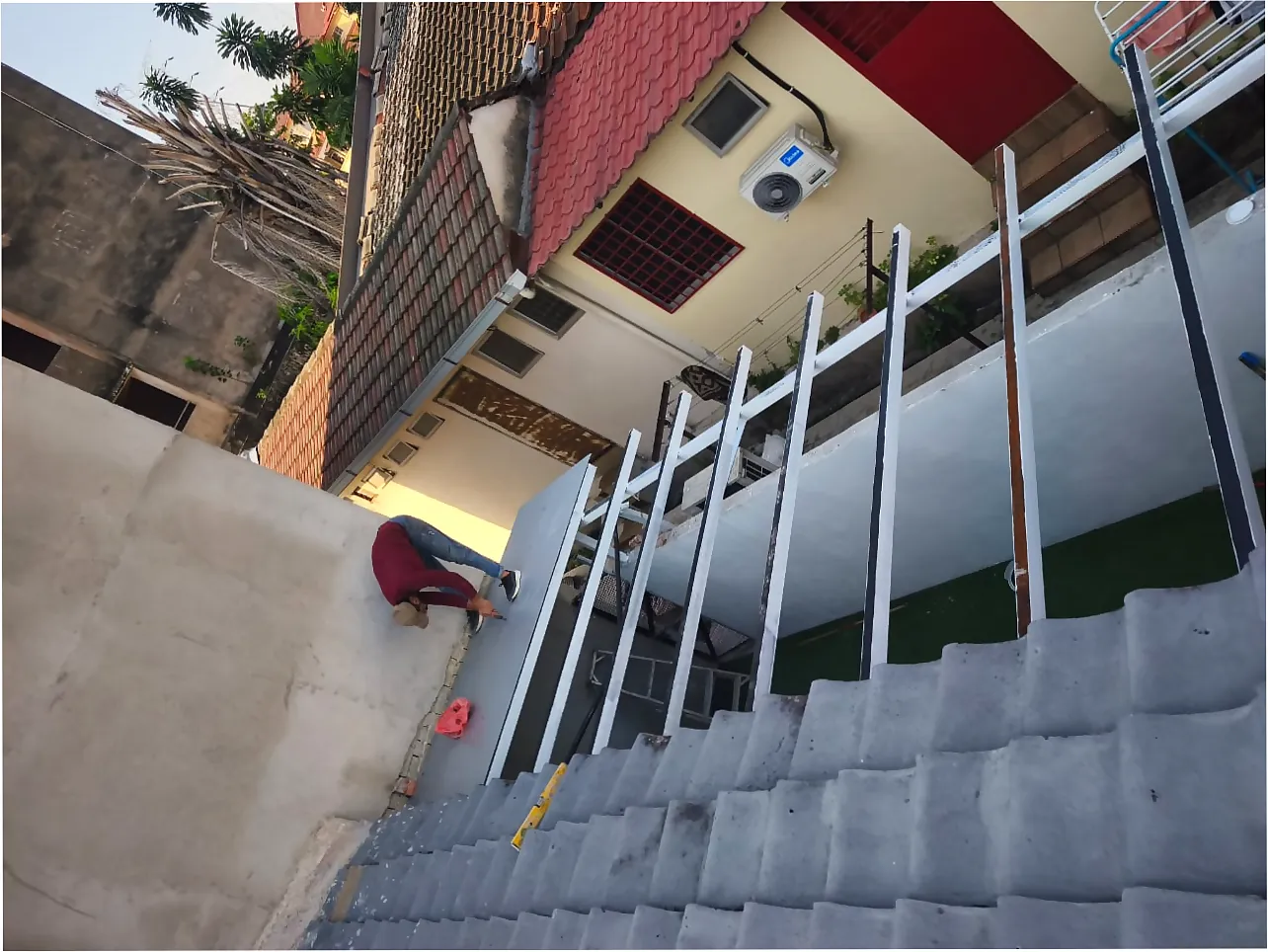
Assess the joint and the load path
We look at why the weld failed, not just where. Rewelding a joint that failed from overload without addressing the load will simply crack again.
Welding & Metal Works Problems
A failed weld is a joint that has stopped carrying load — everything connected to it is now being held by something that was not designed to take the whole job.
What This Problem Means
A clear, honest explanation of what is happening so you know what you are dealing with.
A weld is the point where two pieces of steel were fused into one. When it cracks, the assembly stops behaving as a single structure and starts behaving as separate parts held loosely together. Depending on where that happens, the result ranges from an annoying rattle to a genuine safety concern, as with a railing post or an awning frame bracket.
Welds fail for understandable reasons, and it is not usually a mystery. Either the joint was carrying more load or more repeated flexing than it was designed for, or the weld itself was poorly made — insufficient penetration, contaminated metal, or a fillet far too small for the section. Corrosion in the joint is the third common cause, and in Malaysia it is a frequent one because unprimed welds are where rust starts.
The short answer
A failed weld is a joint that has stopped carrying load — everything connected to it is now being held by something that was not designed to take the whole job.
We explain the cause and the fix, not just the symptom.
Common Causes
Understanding the cause helps you know why it happened and what the right fix is.
Repeated flexing at the joint, as at a gate hinge or a frequently used latch.
The original weld having too little penetration or being undersized for the load.
Corrosion working into the joint and eating away the weld metal.
Impact — a vehicle knock, a heavy fall, or a gate slammed hard over years.
Load added later that the original structure was not designed for.
Welding onto painted or dirty metal at fabrication, giving a contaminated joint.
Warning Signs
Spotting these signs early can often prevent a small problem from becoming a larger repair.
A visible dark line at a joint, often with rust weeping from it.
Movement or play at a point that used to be rigid.
A clicking or knocking sound when the item is used or loaded.
Paint cracked in a straight line exactly along a joint.
Two members that no longer sit at the angle they used to.
Possible Solutions
The practical approaches we take to resolve this problem — from a targeted repair to a fuller solution.
We look at why the weld failed, not just where. Rewelding a joint that failed from overload without addressing the load will simply crack again.
The failed weld is ground out to clean, sound metal and rewelded with adequate penetration and an appropriately sized fillet.
Where the original joint was undersized for what it carries, we add a gusset or increase the weld rather than repeating the original weakness.
The repaired joint is cleaned, primed and coated — an uncoated weld is exactly where the next round of corrosion starts.
When to Call a Professional
Some problems are worth handling early, and some should always be left to a professional. Here is when to get in touch.
The failed weld is on a railing, balustrade, awning frame or anything overhead.
You can see movement at a joint that should be solid.
A gate or grille has visibly changed shape.
A previously repaired weld has cracked again — that means the cause was never addressed.
Related Renovix Service
Cracked or Broken Weld is handled by our Welding & Metal Works team. The related services below are often part of the same job.
Sub-Services
These are the scopes we carry out for this problem. Each one has its own page explaining the work, what is included and what changes the cost.
Under Welding & Metal Works
Under Welding & Metal Works
Under Welding & Metal Works
Under Welding & Metal Works
Our Work
Real photographed jobs from our portfolio whose scope genuinely covers this kind of problem.
Our Process
A good weld repair addresses why the joint failed, so the same joint is not back on the list next year.
We examine the crack and check whether the cause is load, corrosion, impact or an originally poor weld.
The cracked weld and any corroded metal are ground out so the repair goes into clean steel.
The joint is rewelded to an appropriate size, with a gusset or added support where the original design was marginal.
The weld is dressed, primed and coated so the repaired joint is protected from corrosion.
Property Types
Weld failures cluster around whatever moves or carries load most often.
Main gate hinge and latch joints crack first, being the most frequently loaded welds on the property.
Heavier gates, longer railings and carport awning frames put sustained load on more joints.
Balcony grille and drying rack brackets fail at the wall joint, where corrosion and load meet.
Signage frames and shutter guides see high cycle counts and are often the first joints to go.
Original fabrication standards varied, and decades of corrosion mean joints often need reinforcing rather than simply rewelding.
Service Areas
We carry out on-site weld repair for gates, grilles, railings and frames across Kuala Lumpur and Selangor.
The federal capital — heritage shophouses, mid-century landed estates, older flats and a dense high-rise belt, all within one city.
Malaysia's most developed state — from 1950s Petaling Jaya and royal Klang to fast-growing corridors like Puchong, Kota Damansara and Cyberjaya.
Local housing stock, common problems and practical service notes for neighbourhoods and towns across the Klang Valley.
Not sure if we cover your area? Ask us — we serve most Klang Valley locations.
FAQs
Straight answers to the questions customers ask us most about this problem.
Most can be repaired on site. We bring portable welding equipment, and gates, grilles, railings and awning frames are usually repaired in place, which avoids the cost and disruption of removal. Occasionally an item that needs extensive rebuilding is better taken away, and we would tell you that up front.
Because the joint is where the load concentrates. The flat panels of a gate carry very little; the hinge and corner joints carry all of it, and take the flexing every time the gate swings. Add corrosion working into an unprimed joint and it is unsurprising that welds fail before the sections do.
Usually one of two things: the repair was a surface tack that never penetrated into sound metal, or the underlying cause was never dealt with. If a joint is carrying more than it was designed for, rewelding it identically just resets the clock. That is why we look at reinforcement, not only at the weld.
It depends entirely on what the joint holds. A cracked weld on a decorative panel is cosmetic. A cracked weld on a railing post, a balcony grille bracket or an awning frame is a genuine safety concern, because those joints are what stop something falling. Anything overhead or fall-related should be looked at promptly.
A repair weld is dressed back and coated, so on a painted gate or railing it is usually not noticeable once finished. On bare or stainless steel the repair is more likely to show, since the heat and the weld metal alter the surface. We will set expectations before starting.
Related Problems
These issues frequently appear together in Kuala Lumpur and Selangor homes.
Rust on a mild-steel gate is normal in the Malaysian climate — what matters is whether it is surface rust or rust that has eaten through the section.
View problemA railing that moves when you lean on it is a safety problem first and a cosmetic one second — it should be checked rather than lived with.
View problemA gate that drags on the ground or refuses to latch is telling you something has moved — a hinge, a post, a roller or the ground itself.
View problemGet a Free Quote
Describe what you are seeing and where the property is located, and we will advise on the next step.
Call or WhatsApp: +601159259521